

Fonds
Clarence
Alphonse Gagnon was born in Sainte Rose (Laval), on November 8, 1881. His
parents were Alphonse-E. Gagnon and Sarah Ann Wilford. After attending the
École du Plateau in Montreal, Gagnon studied under legendary painter William
Brymner at the Art Association of Montreal (1897 to 1900). His artistic
training was also influenced by mentoring he received from Horatio Walker. In
1899, Gagnon won a scholarship. Even early on, his artistic creations conveyed
his interest in scenes of rural life and showed off his special talent for
engraving. Montreal businessman James Morgan took an interest in the young
artist and funded his studies under painter Jean-Paul Laurens at the Académie
Julian in Paris (1904-1905).
In 1905,
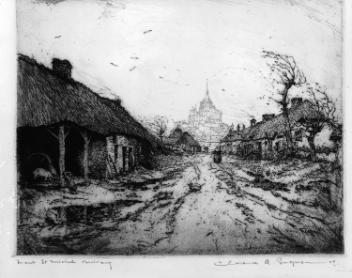
Gagnon's etchings earned him an honourable mention at the Salon des artistes
français in Paris. Gagnon met a number of artists in the City of Light,
including fellow Canadians like painter James Wilson Morrice, with whom he
struck up a friendship and shared artistic techniques.
Gagnon married
Kathryne Irwin in 1907 and together they returned to Quebec. In 1908, he moved
to the Baie St. Paul area, which would remain a major source of inspiration to
him throughout his career. From 1909 to 1914, the artist led a nomadic life,
moving between Canada, France and Norway, all while continuing to paint
pictures based on sketches done in Quebec. In 1913, an exhibition of the Quebec
painter's work was shown in the Montparnasse gallery of Adrien M. Reitlinger.
This event, considered a turning point in Gagnon's career, made him attractive
to both French and Canadian collectors. In the years that followed, Gagnon
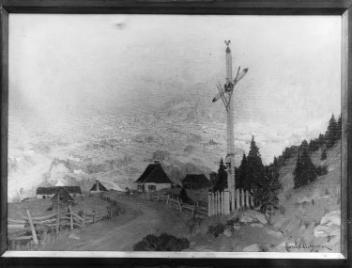
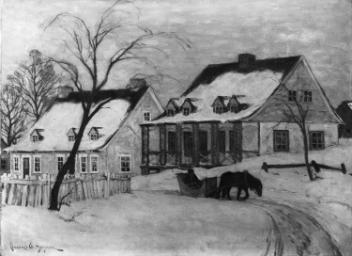
essentially painted Canadian landscapes. He was known for his rural landscapes
(especially of the Laurentians), winter scenes, and depictions of
French-Canadian life.
In 1919,
following the death of his first wife, the artist returned to Canada and
married Lucile Rodier. In 1920, he joined the legendary Beaver Hall Group,
which brought a breath of modernism to Canadian art. He was named a member of
the Royal Canadian Academy of Arts in 1922, and then the Royal Society of
Canada. In 1923, he was awarded the Trevor Prize at the Salmagundi Club
exhibition in New York, for his painting Winter in the Laurentians,
Quebec. Gagnon lived in Paris again from 1924 to 1936, where he worked on two
projects that brought him tremendous renown: the illustrations for the deluxe
edition of The Great While Silence (1929) by Louis-Frédéric Rouquette,
and the illustrations for Maria Chapdelaine (1933) by Louis Hémon. An
exhibition of the original paintings for the latter book successfully toured
Quebec and Ontario. In 1939, 21 of these illustrations were used to decorate
the royal suites in Rideau Hall and the Windsor Hotel in Montreal.
Gagnon
returned to live in Canada with his wife Lucile in 1936 and was given an
honourary doctorate from the Université de Montréal two years later. During
this period, he worked very hard to create an outdoor museum on Ile d'Orléans,
a project that never materialized. He then tried to adapt the idea for Mount
Royal, as part of the festivities commemorating Montreal's 300th anniversary.
Clarence A.
Gagnon died January 5, 1942, at the age of 61.
Scope and Content
The fonds
focusses primarily on the artistic activities of painter, illustrator and
engraver Clarence A. Gagnon. It covers some of his most famous works, notably
the illustrations for the novel Maria
Chapdelaine, as well as exhibitions of his work, the loan of his works to
Montreal's Windsor Hotel, and retrospectives of his work.
The
archives chronicle some of this Quebec artist's pet projects, including
proposed outdoor museums on Ile d'Orléans and Mount Royal. His artistic
interests, such as promoting Quebec handicrafts, are also documented. Moreover,
the fonds records Gagnon's various professional relationships, the associations
he belonged to, and the agencies he worked with to sell his work.
Finally,
the fonds helps trace certain aspects of the personal lives of Gagnon and those
in his circle, such as his personal relationships, travel, and the
commemorative activities that followed his death.
In addition
to notes and texts that Gagnon wrote about art and artists, the fonds contains
documents that discuss his work and the exhibitions featuring this work:
correspondence, exhibition catalogues, invitations, print reproductions of
certain paintings, newspaper clippings and photographs. Other notes, texts
(descriptions and project proposals) and press clippings document the artist's
proposed plans for outdoor museums.
Extensive
correspondence (which includes several transcriptions) chronicles Gagnon's
involvement in the Art Association of Montreal as well as some of his personal
and professional relationships. In particular, there are letters exchanged with
his teacher, painter William Brymner, author and poet Duncan Campbell Scott,
and painters Horatio Walker and Alexander Young Jackson.
Moreover,
the fonds contains various personal and commemorative documents, along with
press clippings about Gagnon's life and his honourary doctorate.
The fonds
is divided as follows:
P116/A
Biography and Honours;
P116/B Artistic Activities;
P116/C Art Association of Montreal;
P116/D Correspondence;
P116/E Lucile Gagnon.
Classification Scheme
P116
Clarence A. Gagnon
P116/A Biography and Honours
P116/A,1 Biographical information
P116/A,2 Honoris causa doctorate
P116/B Artistic Activities
P116/B1 Conferences, notes and art studies
P116/B2 Exhibitions and
work
P116/B2,1 Maria Chapdeleine
P116/B2,2 Decoration of the royal apartment
P116/B2,3 British Empire Exhibition
P116/B2,4 Craft Show
P116/B2,5 Memorial Exhibition
P116/B2,6 Other
P116/B3 Outdoor museum
projects
P116/B3,1 Ile d'Orléans
P116/B3,2 Mount Royal
P116/C Art Association of Montreal
P116/D Correspondence
P116/D1 Rous and Mann Ltd.
P116/D2 National Gallery of Canada
P116/D3 James Morgan
P116/D4 Cleveland Morgan
P116/D5 William Brymner
P116/D6 Duncan Campbell Scott
P116/D7 Horatio Walker
P116/D8 William R. Watson
P116/D9 General correspondence
P116/E Lucile Gagnon
P116/E1 Correspondence
P116/E2 Commemorative
documents
P116/E2,1 Condolence letters
P116/E2,2 Tributes and obituaries
Source
of title proper:
Title based on the creator of the fonds.
Physical
description:
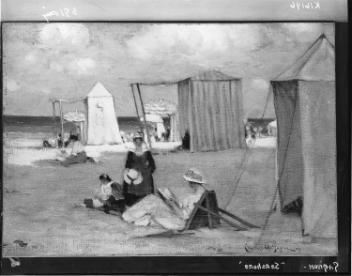
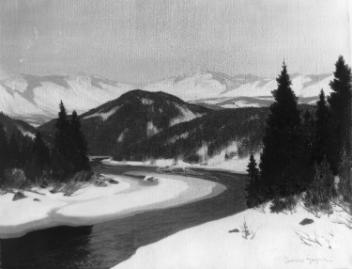
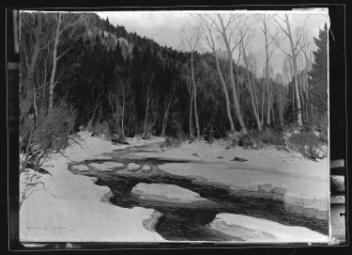
Includes 5 photographs, 2 photographic collages and 3 reproductions of
paintings.
Language: The documents are primarily in
English and French, but some are in Norwegian.
Associated
material: Several
archival fonds contain documents about the life and work of Clarence Gagnon,
including the following:
BAnQ (Quebec City and Old Montreal): Fonds Clarence Gagnon
(MSS37); Fonds Horatio Walker (MSS163); Fonds Jean-Marie Gauvreau (MSS2); Fonds
Ministère de la Culture et des Communications (E6)
Montreal
Museum of Fine Arts: Fonds des expositions du MBAM (MBAM-E1, MBAM-E2)
LAC:
Wilford Gagnon Fonds (R7877-0-1-F); J. Russell Harper Fonds (R2454-0-7-E);
Peter Winkworth Collection of Canadiana (R9266-0-1-E)
Related
groups of records:
Clarence Gagnon's correspondence with James Morgan is preserved in the James
Morgan fonds (P137).
General
note: The Notman
Photographic Archives collection contains photographs of Clarence Gagnon's
work. Fonds P116 provided documentation for the creation of a series about the
artist, broadcast on Radio-Canada.
Last update: March 22, 2019
Information about the objects in our collection is updated to reflect new research findings. If you have any information to share regarding this object, please email reference.mccord@mccord-stewart.ca.Information about rights and reproductions is available here.
This project is made possible thanks to the generous support of the Azrieli Foundation and Canadian Heritage.