

Fonds
Born in
Trois-Rivières, JOSEPH-FRANÇOIS HERTEL DE LA FRESNIÈRE (1642-1722) was an
officer, interpreter and commander. In 1664, in Montreal, he married Marguerite
de Thavenet (1646-1708), with whom he had 15 children. Over the years, he
carried out numerous military exploits, many in the company of his sons, with
whom he shared his war tactics. Governor Louis de Buade de Frontenac recognized
his bravery and service record with letters of nobility in 1716. Through his
wife, Joseph-François inherited the seigneury of Chambly in 1694, which he
subsequently subdivided for several of his sons.
Born in
Trois-Rivières, JEAN-BAPTISTE HERTEL DE ROUVILLE (1668-1722) was the third son
of Joseph-François Hertel de la Fresnière and Marguerite de Thavenet. Like
other members of his family, he took up arms at an early age. During his
career, he became an ensign, a lieutenant and a captain on Isle Royale (Cape
Breton Island), the commander of Port Dauphin (Englishtown, NS), and a knight
of the Order of St. Louis. To reward him for services rendered in defence of
the colony, on January 18, 1694, Governor Frontenac and Intendant Bochart de
Champigny gave Jean-Baptiste a seigneury adjoining that of his father. This
seigneury, which he never inhabited but henceforth bore his name, was crossed
by the Huron River (Richelieu Valley) and bordered by the seigneury of Chambly
to the west, that of Saint-Charles-d'Yamaska to the east, and that of
Saint-Hyacinthe to the south; his domain covered the present-day municipalities
of Mont St. Hilaire (including the mountain), Otterburn Park and
Saint-Jean-Baptiste.
In 1698, he
married Jeanne Dubois, who died less than two years later. In 1708, he married
Marie-Anne Baudouin (1685-1745), the eldest daughter of Dr. Gervais Baudouin.
Following his death, in 1724 she rendered fealty and homage to the governor for
the seigneury of Rouville, which she shared with her children.
JEAN-BAPTISTE-FRANÇOIS HERTEL DE ROUVILLE (1709-1773) was
the son of Jean-Baptiste Hertel de Rouville and Marie-Anne Baudouin. A military man like his father, he
was named the commander of Fort Chambly, and then a knight of the Order of St.
Louis in 1762. In Montreal in 1733, he married Marie-Anne Legras (1696-1776),
the daughter of merchant-tanner Jean Legras and Geneviève Mallet. Since he had
little time to devote to the seigneury, his wife became his legal
representative and ran the family's affairs. The couple had three daughters,
all of whom died young. With no direct heir, Jean-Baptiste-François sold his
share of the seigneury of Rouville and all his inheritance rights to his
brother René-Ovide in 1772.
Born in
Port Toulouse (St. Peter's, NS), RENÉ-OVIDE HERTEL DE ROUVILLE (1720-1792) was
the son of Jean-Baptiste Hertel de Rouville and Marie-Anne Baudouin. Unlike his
father and brothers, he chose to study law rather than enter the military. In
1741, he married Louise-Catherine André de Leigne (1709-1766), the daughter of
Pierre André de Leigne and Claude Fredin. The couple had five children and
lived in Trois-Rivières.
Named a civil and criminal lieutenant general (judge) at the age of 24, he also
took on the administration of the St. Maurice ironworks in 1750. After his
first wife died, he married Charlotte-Gabrielle Jarret de Verchères
(1735-1808), the widow of Pierre-Marie-Joseph Raimbault de Saint-Blaint, in
Montreal in 1767. Under the British regime, he was appointed surveyor of
highways for the district of Montreal in 1765, and then a conservator of the
peace and commissioner for the district of Montreal in 1775, much to the
displeasure of his compatriots. After the American rebels abandoned Montreal in
1776, René-Ovide returned to his duties as a magistrate, becoming a judge of
the Court of Common Pleas. Upon his death in Montreal, the seigneury of
Rouville was handed down to his son Jean-Baptiste-Melchior.
Born in
Trois-Rivières, JEAN-BAPTISTE-MELCHIOR HERTEL DE ROUVILLE (1748-1817) was the
son of René-Ovide Hertel de Rouville and Louise-Catherine André de Leigne. An
army and militia officer, he defended the British crown when American troops
invaded Canada in 1775. Appointed justice of the peace for the district of
Montreal in 1783, the following year he married Marie-Anne Hervieux
(1750?-1819), the daughter of Jean-Baptiste Hervieux, a Montreal merchant. The
couple had at least eight children.
Owner of
half a league of frontage in the seigneury of Chambly, Jean-Baptiste-Melchior
received an advance on his inheritance from his father of half a league of
frontage in Chambly with a flour mill and purchased an additional half a league
in the same location. He settled there in 1789 and obtained a commission as
militia colonel the following year. Upon his father's death in 1792, under the
rules of primogeniture, he inherited half of the seigneury of Rouville and part
of the seigneury of Chambly. A supporter of the British regime, like his
father, that same year he became a member in the first parliament and, in 1812,
was appointed to the Legislative Council. He was also made commander of the
Chambly 2nd Militia Battalion. In 1813, he was named justice of
the peace for the districts of Quebec City, Montreal and Trois-Rivières. Buried
in Chambly, he bequeathed the entire seigneury of Rouville (having purchased
the other half in 1797) and his share of the seigneury of Chambly to his son
Jean-Baptiste-René.
Born in
Montreal, JEAN-BAPTISTE-RENÉ HERTEL DE ROUVILLE (1789-1859) was the son of
Jean-Baptiste-Melchior Hertel de Rouville and Marie-Anne Hervieux. He pursued a
military career and became a militia officer. Among his exploits, he took part
in the Battle of Châteauguay in 1813 with his brother-in-law Charles-Michel
d'Irumberry de Salaberry, who was married to his sister Marie-Anne-Julie Hertel
de Rouville. In 1815, he was made lieutenant colonel of the Chambly battalion,
assuming command in 1816. The same year, he married Anne Charlotte de
Labroquerie (Boucher de La Broquerie) (1796-1852), with whom he had at least
five children.
Under the
terms of his father's will, drawn up in 1814, Jean-Baptiste-René inherited the
seigneury of Rouville and part of the seigneury of Chambly. However, the will
further stipulated that he could not take possession of this property until the
death of his mother; she died January 25, 1819. He became the first seigneur in
his family to take up residence in the seigneury of Rouville. The construction
of his manor house in St. Hilaire began in 1819 and, approximately two years
later, he drew up his terrier (property register). Elected a member of the
Legislative Assembly of Quebec at the age of 35, he then served on the
Legislative Council between 1837 and 1838. The target of much criticism,
notably with regard to his loyalty during the Patriot Rebellions,
Jean-Baptiste-René found that his reputation suffered in the years following.
Ailing and in financial difficulty, he left his manor house and asked his
son-in-law, Dr. Jean-Baptiste Brousseau, to sell the seigneury of Rouville. On
April 16, 1844, the seigneury was sold to military officer and politician
Thomas Edmund Campbell. He died in Boucherville.
Born in
London, THOMAS EDMUND CAMPBELL (1811-1872) arrived in Canada in 1837 after
serving in the British Army. He was quickly promoted to commander following the
Rebellions of 1837-1838 and was made a colonel several years later. In 1841, he
married Henriette-Julie Juchereau Duchesnay (1813-1873), the daughter of
seigneur Michel-Louis Juchereau Duchesnay and
Charlotte-Hermione-Louise-Catherine d'Irumberry de Salaberry. Three years
later, he purchased the seigneury of Rouville and, in 1846, moved to St.
Hilaire where he devoted himself to developing his land. Among other things, he
erected the dam on Lake Hertel, rebuilt the seigneurial mill, promoted
water-powered industry, and constructed the first school in the region. From
1847 to 1849, he held the positions of civil secretary for the governor of Canada
and superintendent of Indian affairs. From 1858 to 1861, he sat as the member
of parliament for Rouville and also became a director of the Bank of Montreal
and the Grand Trunk Railway. He died in St. Hilaire.
Following
the death of Thomas Edmund Campbell, the seigneury was handed down to his
eldest son, EDMUND ALEXANDER CHARLES CAMPBELL (1843-1902), who subsequently
left it to his brothers in 1884. They soon ran into financial difficulties,
leading them to subdivide the seigneury in 1892. The mountain was sold off in
1908 and the farm in 1942. The manor house remained the property of the
Campbell family until the 1955 death of Mabel Allen, daughter of Sir Hugh Allan
and the widow of Colin Campbell.
Scope and Content
This fonds
focusses on the history of the seigneurs of Rouville and their management of
the domains of Rouville and Chambly, primarily from the late 17th century
until the seigneurial regime was abolished in the mid-19th century. It
chronicles the administration of the censives (landholdings), the collection of
feudal revenues, and the construction of flour mills for the use of the
censitaires (tenant farmers).
There is an
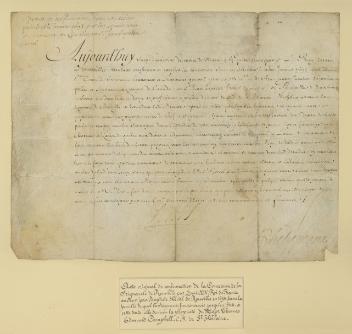
original 1695 certificate (and three copies) signed by Governor Frontenac and
Intendant Champigny, granting the seigneury to Jean-Baptiste Hertel de
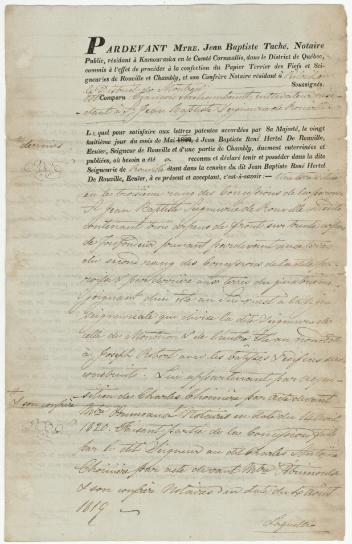
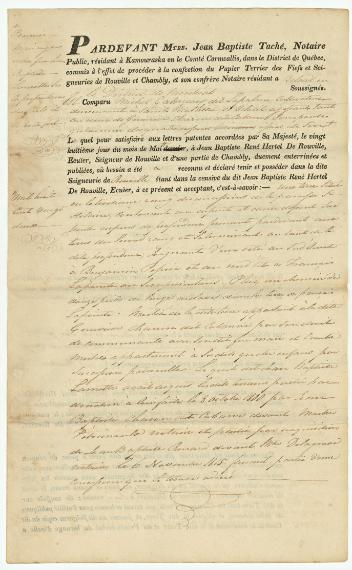
Rouville. Several land grants and deeds of sale, survey reports, a map dated
1844, terriers and leases illustrate how the land in the seigneury of Rouville
was distributed, what it was used for, and the revenues it generated.
A photocopy
of an account book, apparently kept by Jean-Baptiste-Melchior Hertel de
Rouville in the early 19th century, provides a record of all
the expenses and revenues of the seigneury of Rouville, along with several
poems, a recipe for a natural medicine, and personal notes on his ancestors. An
estimate of the rents received by the domain of Rouville, a lease for a sugar
bush located on the land of Thomas Edmund Campbell in St. Hilaire, and lists of
the inhabitants of the domain of Chambly document the management and accounts
of the seigneuries.
In
addition, the fonds includes contracts of association regarding the seigneurial
mills of Chambly and Rouville. The first, dated 1705, is signed by
Joseph-François Hertel de la Fresnière and the governor of Montreal, Claude de
Ramezay, while the second, dated 1745, is signed by Marie-Anne Legras and Louise
de Ramezay. Legal documents chronicle the dispute between the seigneurs of
Rouville and Charlotte Denys de La Ronde, the widow of Claude de Ramezay, with
regard to the operation of the mill located on the Huron River and a claim for
unpaid seigneurial rents. Account books kept by Joseph Rousseau from 1848 to
1860 and J. Lahaise from 1888 to 1896 document the quantities and types of
grains milled and sold at the seigneury of Rouville.
Finally,
the fonds is completed by a typewritten text by Armand Cardinal that traces the
history and genealogy of the seigneurs of Rouville, accompanied by a photograph
of the author and the owners of the Rouville Campbell Manor, circa 1963.
Classification Scheme
P107
Seigneurs of Rouville
P107/A Genealogy
P107/B Domain of Rouville
P107/B1 Censives (landholdings)
P107/B2 Feudal expenses and
revenues
P107/B3 Seigneurial mill
P107/B3,1 Contract of
association
P107/B3,2 Account books
P107/C Domain of Chambly
P107/C1 Censives (landholdings)
P107/C2 Feudal revenues
P107/C3 Seigneurial mill
P107/D Photograph
Variations
in title: Formerly
known as the Rouville Fonds and the Seigneurie de Rouville Fonds.
Source
of title proper: Based
on the creators of the fonds.
Physical
condition: Several
documents are damaged and fragile.
Immediate
source of acquisition: While the majority of the documents were donated by Mr. John L.
Russell in 1963, the fonds is comprised of a variety of records donated between
1917 and 2005.
Language: The documents are in French.
Finding
aids: List of
individual documents available.
Associated
material:
BAnQ
(Old Montreal):
Fonds seigneurie de Rouville-Campbell (P265)
Société
d'histoire de la seigneurie de Chambly: Collection Paroisse
Saint-Mathias-sur-Richelieu (P061)
General note: The McCord Museum's collection of Paintings, Prints and Drawings
includes several portraits of the seigneurs of Rouville painted in the 18th and
19thcenturies.
Last update: June 5, 2018
Information about the objects in our collection is updated to reflect new research findings. If you have any information to share regarding this object, please email reference.mccord@mccord-stewart.ca.Information about rights and reproductions is available here.

This project is made possible thanks to the generous support of the Azrieli Foundation and Canadian Heritage.